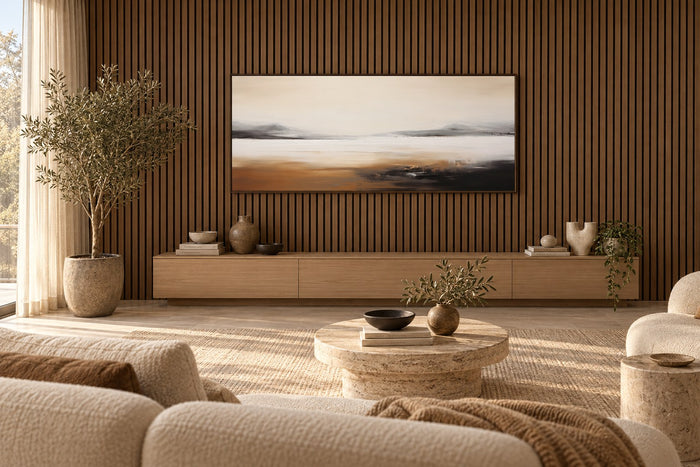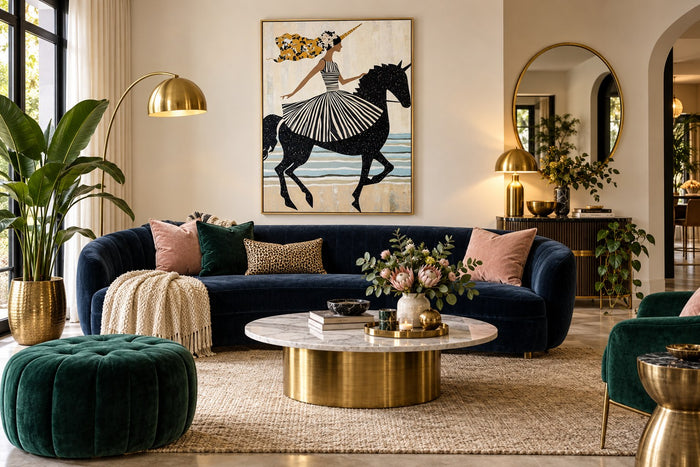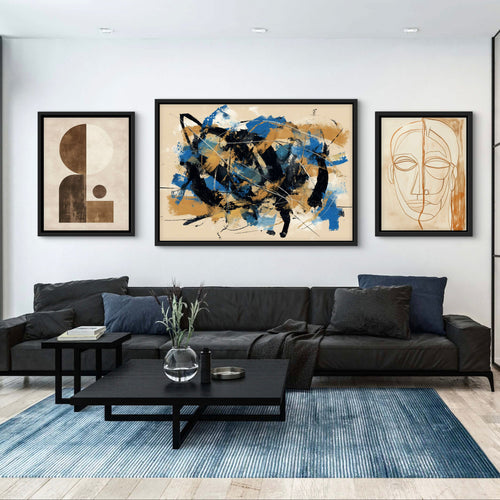

Japandi works because it asks for restraint. Japanese calm meets Scandinavian warmth, and the result is a home with fewer things, each chosen with care. If you are searching for japandi interior design south africa, the good news is that our makers already work in the right language: clay, wool, timber, honest finishes and simple form.
The trick is in the pairings. Here is how we would put the look together, using oat, warm grey, soft black, clay and pale oak, with quiet abstract art doing the emotional work on the walls.
The Japandi palette, and why it holds together
Oat and warm grey form the base, pale oak brings lightness, clay adds a pulse of earth, and soft black draws the lines. Keep black to small doses: a frame, a lamp base, a chair leg. It works like ink on paper, giving definition without heaviness.
Texture does what pattern would do elsewhere. Think slubby wool, glazed stoneware, brushed timber and the faint grain of a charcoal mark. When colour is this quiet, your eye reads surface first, so every material needs to earn its place.
Living room: low, light and layered
Start with the big pieces. LIM designs and makes its furniture in Cape Town around modern minimalism and refined proportion, and its living room range includes sofas, daybeds, ottomans, coffee tables and side tables. A low-slung sofa and a simple coffee table give you the clean horizontal lines Japandi depends on. If you want a particular size or finish, LIM also offers bespoke furniture.
Underfoot, bring in softness. Coral + Hive weaves custom rugs on its looms from natural fibres, including Karakul wool, mohair, jute, abaca and New Zealand wool. A plain or tone-on-tone wool rug in an oat shade grounds the room, while a jute piece adds a flatter, more textural note. Both sit comfortably under pale timber, and both can be made to suit your room through a custom design consultation.
Above the sofa, hang the Earthy Minimalist Triptych. Three panels create a calm rhythm, and the earthy, neutral tones echo clay and oat without competing with them. For a quieter spot, such as above a sideboard or beside a window, the Neutral Geometry Abstract Composition adds a contemplative, geometric counterpoint.
If you want an original in the mix, StateoftheART Gallery in Stanford has sold exclusively curated original South African art since 2010. Its browse filters let you narrow by Abstract or Landscape subject, and by Minimalist artists, which is a useful shortcut for this look. Look for a soft, light-filled landscape or a restrained abstract, and let it hang alone on a wall with generous space around it.
Finish the table with ceramics. Mother Earth Pottery in Montagu makes wheel-thrown pieces using raku and saggar firing, adapted and modernised, and the smoky, uneven surfaces are a natural fit for Japandi's love of imperfection. A single raku vase on the coffee table is plenty.
Bedroom: the quietest room in the house
Here you want almost nothing. A low bed, two pedestals and a clear wall. LIM's bedroom range covers beds, pedestals and drawers, and its homeware includes table lamps and wall sconces, so you can keep the whole bedside story within one design language. Wall sconces free up the pedestal surface, which keeps things uncluttered.
For the wall above the bed, choose Abstract Zen. The name says it, and its soft, open composition suits a room meant for winding down. If you prefer something more linear, Neutral Lines brings a gentle structure that reads well against warm grey walls.
Add one original for depth. Karnish Art in Cullinan, Pretoria, builds rich textures in oils, acrylics, pastels, graphite and charcoal, exploring nature, movement and emotion. Her work is vibrant by nature, so in a Japandi bedroom treat a single canvas as the one expressive note, and let the plain linen, pale timber and print around it provide the quiet.
Styling tip: keep bedside surfaces to three things at most, such as a lamp, a book and a small stoneware cup or dish.
Dining room: where craft is used every day
The dining room is where Japandi becomes practical. LIM's dining collection includes tables, benches, dining chairs, sideboards and stools. A simple table with a bench on one side is a very Scandinavian move, and it softens the formality of a row of chairs.
Then set the table with intention. Vorster & Braye Ceramic Design hand-crafts contemporary ceramics in Cape Town, elegant in their simplicity, and its range includes tableware, decorative pieces and planters. The Carve Bowl in the low size and the Contour Cup are good examples of the plain, tactile forms that suit this look, and a Dry Goods Jar makes a tidy sideboard accent. Mix them with Mother Earth Pottery's organic Stoneware and Caveware dinner sets, which you can order, for a table where no two pieces match exactly but everything agrees.
For something with a little more story, Rialheim shapes ceramics by hand from African clay at its studio at Clairvaux Estate in Robertson, finished in signature glazes. Its range includes vases, planters, candle holders and lighting. A glazed vase or candle holder in a clay tone can anchor the centre of the table.
On the wall, the Black beige abstract framed art brings in your soft black and oat in one frame. Hang it over the sideboard, centred, and keep the sideboard top mostly bare: one vessel, one candle, nothing else.
A simple pairing formula
- One art, one object: match each artwork with a single ceramic that borrows one of its colours.
- Two textures per surface: for example wool and timber, or glaze and linen.
- Soft black once per vignette: a frame, a lamp, a chair leg.
- Leave a wall-width of space: allow roughly the width of the artwork as empty wall on each side where you can.
- Light low and warm: use lamps and sconces rather than a single overhead source.
Scale, light and the art of leaving things out
Japandi rooms feel generous because the scale is right. Hang art lower than you think, so its centre sits near eye level when you are seated in the living room. Choose one large piece rather than several small ones, and let furniture stay low so the wall can breathe.
Light matters just as much. LIM's ceiling pendants, floor lamps and table lamps give you layers, and a pendant over the dining table keeps the light intimate. In daytime, keep curtains sheer and plain so the pale oak and oat tones glow rather than flatten.
Finally, edit. Fill a room slowly, live with it for a few weeks, and remove anything that is only there to fill space. The calm you are after usually arrives when the last thing leaves.
Are you a South African artist or décor business whose work belongs in a calm, considered home? We would love to hear from you. Find out how to be featured on our SA Businesses We Love page.
Shop the look
Artworld wall art in this pairing
 Earthy Minimalist TriptychArtworld · canvas & framedFrom R375 →
 Neutral Geometry Abstract CompositionArtworld · canvas & framedFrom R375 →
 Abstract ZenArtworld · canvas & framedFrom R375 →
 Neutral LinesArtworld · canvas & framedFrom R375 →
 Black beige abstract framed artArtworld · canvas & framedFrom R375 →
The South African businesses in this look
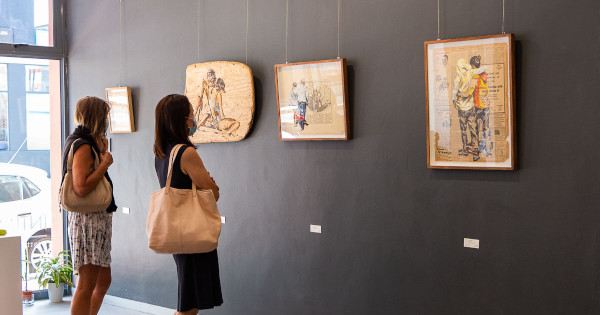 StateoftheART GalleryStudio & gallery · StanfordExceptional contemporary South African art, carefully curatedVisit website →
 Karnish ArtAbstract painter · Cullinan (Pretoria)Layered abstract worlds, painted from the soulVisit website →
 LIMFurniture · Cape TownContemporary furniture, crafted in Cape Town since 1997Visit website →
 Vorster & Braye Ceramic DesignCeramics & pottery · Cape TownContemporary ceramics, handcrafted in Cape TownVisit website →
 Mother Earth PotteryCeramics & pottery · MontaguHandmade ceramics rooted in South African earthVisit website →
 RialheimCeramics & pottery · RobertsonCollectable ceramics handcrafted in South African clayVisit website →
 Coral + HiveRugs & textiles · Somerset WestCustom handwoven rugs from natural fibresVisit website →
Room photo: a styled scene created for Artworld featuring Abstract Zen. Business photos are from each business's own website or Instagram.